Timemore C5 ESP Pro Manual Coffee Grinder vs Timemore Chestnut C3 ESP Pro Black Manual Coffee Grinder
We compare the Timemore C5 ESP Pro Manual Coffee Grinder and the Timemore Chestnut C3 ESP Pro Black Manual Coffee Grinder across every dimension that matters - our scores, the key specs, and how each performs on the things you will actually notice day to day.
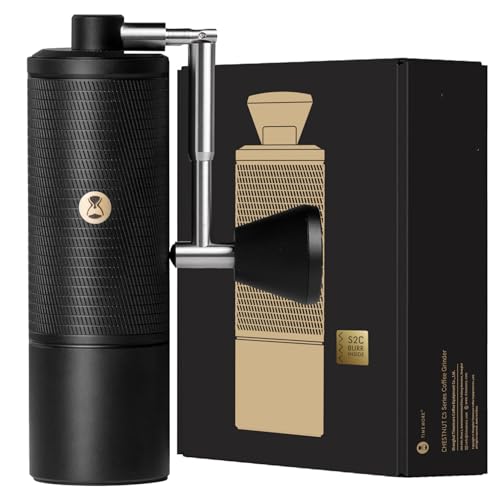

At a glance
| Timemore C5 ESP Pro Manual Coffee Grinder | Timemore Chestnut C3 ESP Pro Black Manual Coffee Grinder | |
|---|---|---|
| Our score | 9.4/10 | 8.6/10 |
| Best for | Home baristas who want consistent, adjustable grinding across 50 settings | Home baristas who want consistent burr grinding |
| Not ideal for | Anyone after the cheapest blade grinder or cafe-level throughput | Anyone after the cheapest blade grinder or cafe-level throughput |
| Brand | Timemore | Timemore |
Design and Build Quality
Timemore C5 ESP Pro Manual Coffee Grinder
This coffee grinder's C5 ESP Pro is built around an all-metal, one-piece aluminium body, helping keep the grinder rigid while still remaining relatively easy to hold and carry. Build details feel purposeful: the unit uses CNC-machined stainless steel conical burr components and a compact 53mm body. The folding handle improves portability, and the grinder can be disassembled for cleaning by brushing. Sturdy alignment is supported by a double bearing central axis, and the metal mass can feel substantial during longer use.
Timemore Chestnut C3 ESP Pro Black Manual Coffee Grinder
Design-wise, the Chestnut C3 ESP Pro Black uses an all-metal aluminium alloy body. It is built for repeated use and helps spread heat during grinding sessions, reducing exposure of internal parts to damage. In hand, the manual coffee grinder feels solid, and it weighs 530 g, making it manageable for travel or home. The foldable crank handle supports easier storage, and disassembly for cleaning is straightforward with a brush. Durability depends on careful handling because there is no protection against hard drops.
Burr Type and Grind Quality
Timemore C5 ESP Pro Manual Coffee Grinder
42mm stainless steel conical burrs form the core of the Timemore, using the manufacturer's patented S2C-042-III design for higher precision and efficiency. The coffee grinder aims for consistent particle size, because double bearing central axis positioning helps keep grinding uniform. The grinder supports fine-to-coarse work across espresso to French press styles, with minor adjustment of about 0.015mm per click and roughly 50 levels overall. Final texture still depends on the beans and the user's technique.
Timemore Chestnut C3 ESP Pro Black Manual Coffee Grinder
Inside this coffee grinder Pro Black, grind performance is driven by its S2C patent conical burr. The conical design is said to produce a more even particle mix, supporting steady flavour extraction. As beans pass between the burr surfaces, the burr cuts rather than relies on impact, producing multiple particle sizes. The manufacturer also states that heat generation is minimal, which helps preserve delicate aromatics. Actual uniformity can still vary with bean freshness and how the burr is used, as these factors affect burr wear and performance.
Grind Settings and Consistency
Timemore C5 ESP Pro Manual Coffee Grinder
With the S2C-042-III burr setup already focused on uniform grinding, the Timemore's grind settings affect how closely different drink styles can be matched. The adjustment is approximately 0.015mm per click, with about 50 grind levels, so fine changes are practical. For consistency, the central axis positioning with a double bearing helps keep particles even as the handle turns. Users can set fineness by rotating the adjustment nut clockwise for finer powder, or anti-clockwise for coarser. Still, step changes can be felt, so repeated test shots may be needed when dialling in, as noted in the coffee grinder.
Timemore Chestnut C3 ESP Pro Black Manual Coffee Grinder
Grind settings and consistency matter because they control how quickly water can extract flavour, and they influence whether the coffee tastes balanced or uneven. The Timemore Pro Black manual coffee grinder review notes an adjustable grind setting, which lets users move between finer and coarser grind for different brew styles. The brewer selects a target grind, then turns the crank steadily, aiming for the same rhythm each time. If the grind shifts during grinding, extraction can become uneven, with sourness or bitterness standing out. Consistent settings help.
Hopper and Bean Capacity
Timemore C5 ESP Pro Manual Coffee Grinder
For the Timemore C5 ESP Pro, hopper and bean capacity matter because they determine how much coffee can be loaded before grinding, shaping the flow during espresso dial-in. In the Timemore manual (UK context), the stated bean capacity is 0.8 kilograms, which supports preparing multiple drinks. The grinder's all-metal one-piece enlarged body is designed to hold beans for longer sessions, helping reduce refill interruptions. For best control, measure beans for the target dose, fill the hopper, then adjust grind settings before grinding. If the capacity is exceeded, fresh beans may not feed evenly.
Timemore Chestnut C3 ESP Pro Black Manual Coffee Grinder
The coffee grinder Pro Black uses a hopper-and-grind workflow where the amount of beans on hand affects how long each session can run before refilling. In practical use, this manual coffee grinder is positioned for typical home batches, and its storage capacity is linked to its specified weight of 530 grams. During grinding, the hopper holds beans until the supply is reduced enough to require attention. For larger drinks, weighing out beans first helps keep timing consistent, with the hopper refilled as needed.
Noise Level and Speed
Timemore C5 ESP Pro Manual Coffee Grinder
Noise level and speed are largely determined by the coffee grinder being a manual grinder, so the primary sound comes from the grinding action rather than a motor. The "speed" is also user-controlled because it depends on how consistently the handle is turned. The all-metal body and 42 mm conical burr call for steady, moderate effort, particularly when targeting fine espresso settings. With around 50 grind adjustments, the user turns the adjustment nut and then grinds at a pace they control. If the handle speed slows during the grind, output consistency drops, while the noise level stays broadly similar.
Timemore Chestnut C3 ESP Pro Black Manual Coffee Grinder
Because the hopper-and-bean workflow mainly affects how often someone must refill the grinder, the next practical consideration becomes the grinding experience in real use, particularly noise level and pace. With the Timemore Pro black manual coffee grinder, speed is primarily determined by crank rhythm, since the foldable handle and adjustable settings require consistent turning. Many users will notice a steady mechanical sound rather than a quiet hum, because a conical burr cuts continuously. The S2C patent conical burr is designed to produce an even grind, which can reduce re-grinding. A controllable pace is a clear benefit, while the need for steady, consistent effort is the main trade-off.
Static and Retention
Timemore C5 ESP Pro Manual Coffee Grinder
Static and retention matter because the Timemore is designed to grind fine settings and coarser ones, and finer coffee grounds can cling more easily to metal surfaces. Static shows up as stray grounds around the burr area and chute, which is more noticeable when aiming for espresso-like fineness. Retention happens because grounds can remain in the grinder body after a batch, so a small carryover is expected. For day-to-day use, brushing and gentle tapping help clear buildup, and a quick check of the hopper reduces inconsistency. Overall, the coffee grinder's manageable retention requires extra cleaning for fine grinds.
Timemore Chestnut C3 ESP Pro Black Manual Coffee Grinder
Static and retention are key issues for manual grinders, as fine coffee particles can adhere to the walls and contribute to mess and inconsistent dosing. In the coffee grinder Pro Black manual coffee grinder and the comparison with alternatives, static may be more noticeable at finer settings, where more dust-like grounds remain attached after each grind. Retention also depends on how fully grounds slide out of the body and the chute, then into the dosing cup. Users can reduce loss by disassembling for cleaning, with brushing only as specified, and tapping out residual grounds.
Learning Curve and Daily Operation
Timemore C5 ESP Pro Manual Coffee Grinder
This coffee grinder has a fairly gentle learning curve, because its grind adjustment is very fine, with about 0.015mm change per click and roughly 50 grind settings ranging from fine to coarse. In daily use, the user selects a starting setting, then tweaks one or two clicks at a time, tasting after each small change. The adjustment nut works clockwise for finer powder and anti-clockwise for coarser, and the handle turns smoothly. Releasing the hand may still let it coast briefly, which can help keep grinds consistent. For buyers comparing The Timemore price, the operating learning is mostly setup and dial-in.
Timemore Chestnut C3 ESP Pro Black Manual Coffee Grinder
Getting consistent results with the Timemore Chestnut C3 ESP Pro Black takes practice because the grinder uses an adjustable grind setting intended to cover French Press, Drip Coffee, Espresso, and Turkish Brew. In daily operation, the routine is straightforward: beans go in, the grind setting is selected, then the foldable handle is cranked until the desired dose is reached. The all-metal body and S2C patent conical burr help the grind stay even, but dialling in still matters for best results. Searches for "The Timemore best price uk" tend to be useful only after routine use is established.
Cleaning and Maintenance
Timemore C5 ESP Pro Manual Coffee Grinder
After dialling in grind settings during daily operation, cleaning and maintenance help the Timemore C5 ESP Pro keep its performance consistent over time. The coffee grinder manual and Amazon listing state that it is easy to clean using a brush, and that the grinder can be disassembled for cleaning. After each session, brush out grounds from the burr area and chute, then wipe the exterior with a dry cloth. For deeper cleaning, parts can be taken apart and then reassembled, as long as burr alignment is kept correct. A light touch helps avoid scratching metal surfaces, and liquids should be avoided except where the instructions state otherwise.
Timemore Chestnut C3 ESP Pro Black Manual Coffee Grinder
Cleaning the coffee grinder Pro Black is fairly simple, as the manufacturer specifies it can be disassembled for cleaning and brushed out. First, the hopper and grounds are fully emptied. Next, the grinder is taken apart, then the burr area and chute are brushed clean with a dry brush, since the brand calls out brushing only. After brushing, the parts are reassembled, and the adjustable grind setting is checked to make sure nothing binds. The all-metal aluminium alloy body can be wiped clean with a dry cloth, but the manufacturer does not mention water-washing. Regular brushing helps reduce stale buildup in the Timemore coffee grinder.
Who Is This Grinder For?
Timemore C5 ESP Pro Manual Coffee Grinder
This grinder suits people who want manual control and repeatable espresso-to-brewing adjustments, without needing any power. This coffee grinder is especially relevant for home users who regularly switch between espresso, French press, and other methods, because it offers about 50 grind settings and fine click changes of 0.015 mm. It also suits those who prefer an all-metal, one-piece aluminium body with a 42 mm conical burr, as it is designed for light force and includes a folding handle. It is less ideal for shoppers seeking effortless, automatic grinding, as it requires turning the handle.
Timemore Chestnut C3 ESP Pro Black Manual Coffee Grinder
This grinder suits people who want a compact manual conical burr option for dialing in grind size at home, with routine brushing and occasional disassembly. The coffee grinder Pro Black is suitable for switching brew styles because it offers adjustable grind settings for fine or coarse grounds. Its all-metal aluminium alloy body and 530 g weight make it practical for frequent use, and manual grinding is implied since no electric option is mentioned. It is also a fit for those who are prepared to grind by hand.
Timemore C5 ESP Pro Manual Coffee Grinder: pros
- Stainless steel conical burrs for an even, consistent grind (42mm)
- 50 grind settings, from espresso to filter
- Aluminium build
Cons
- Burrs need periodic cleaning to keep the grind consistent
- Some grind retention between doses is normal
Timemore Chestnut C3 ESP Pro Black Manual Coffee Grinder: pros
- Stainless steel conical burrs for an even, consistent grind
- Stainless steel build
Cons
- Burrs need periodic cleaning to keep the grind consistent
- Some grind retention between doses is normal
Our verdict
Our pick is the Timemore C5 ESP Pro Manual Coffee Grinder (our score 9.4/10) - A stainless steel conical burr coffee grinder with 50 grind settings, a solid pick for dialling in espresso and filter coffee at home. The Timemore Chestnut C3 ESP Pro Black Manual Coffee Grinder is still worth it if it is cheaper when you check, or if it better matches your specific needs.