Timemore C5 ESP Pro Manual Coffee Grinder vs Timemore Chestnut C3S Max Coffee Grinder Manual
We compare the Timemore C5 ESP Pro Manual Coffee Grinder and the Timemore Chestnut C3S Max Coffee Grinder Manual across every dimension that matters - our scores, the key specs, and how each performs on the things you will actually notice day to day.
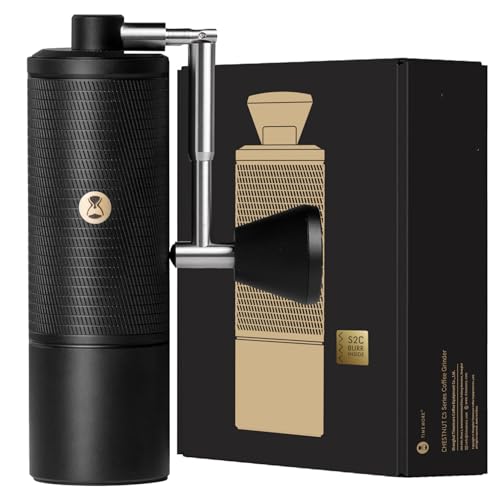

At a glance
| Timemore C5 ESP Pro Manual Coffee Grinder | Timemore Chestnut C3S Max Coffee Grinder Manual | |
|---|---|---|
| Our score | 9.4/10 | 9.4/10 |
| Best for | Home baristas who want consistent, adjustable grinding across 50 settings | Home baristas who want consistent, adjustable grinding across 36 settings |
| Not ideal for | Anyone after the cheapest blade grinder or cafe-level throughput | Anyone after the cheapest blade grinder or cafe-level throughput |
| Brand | Timemore | Timemore |
Design and Build Quality
Timemore C5 ESP Pro Manual Coffee Grinder
This coffee grinder's C5 ESP Pro is built around an all-metal, one-piece aluminium body, helping keep the grinder rigid while still remaining relatively easy to hold and carry. Build details feel purposeful: the unit uses CNC-machined stainless steel conical burr components and a compact 53mm body. The folding handle improves portability, and the grinder can be disassembled for cleaning by brushing. Sturdy alignment is supported by a double bearing central axis, and the metal mass can feel substantial during longer use.
Timemore Chestnut C3S Max Coffee Grinder Manual
Sturdy and practical, this coffee grinder (C3S Max) uses an all-metal, one-piece enlarged body built around a CNC-machined stainless steel conical burr (38 mm). Folding handles help reduce overall bulk for travel. Build quality feels solid, and the compact body suits smaller hands. The adjustment nut provides about 36 coarseness levels, though small hands may find fine turns fiddly. Cleaning is straightforward because parts disassemble for brushing.
Burr Type and Grind Quality
Timemore C5 ESP Pro Manual Coffee Grinder
42mm stainless steel conical burrs form the core of the Timemore, using the manufacturer's patented S2C-042-III design for higher precision and efficiency. The coffee grinder aims for consistent particle size, because double bearing central axis positioning helps keep grinding uniform. The grinder supports fine-to-coarse work across espresso to French press styles, with minor adjustment of about 0.015mm per click and roughly 50 levels overall. Final texture still depends on the beans and the user's technique.
Timemore Chestnut C3S Max Coffee Grinder Manual
With a 38 mm CNC-machined stainless steel conical burr at its core, the Timemore (C3S Max) is designed to grind coffee beans in a consistent way. It uses a central-axis setup with double bearings to support even grinding. The burr hardness is stated as 55-58HRC, produced using 5-axis CNC machining. The grinder is described as nearly avoiding overly coarse grains and minimising fine powder generation, which indicates a focus on reducing extremes in particle size. Burr alignment is identified as a strength.
Grind Settings and Consistency
Timemore C5 ESP Pro Manual Coffee Grinder
With the S2C-042-III burr setup already focused on uniform grinding, the Timemore's grind settings affect how closely different drink styles can be matched. The adjustment is approximately 0.015mm per click, with about 50 grind levels, so fine changes are practical. For consistency, the central axis positioning with a double bearing helps keep particles even as the handle turns. Users can set fineness by rotating the adjustment nut clockwise for finer powder, or anti-clockwise for coarser. Still, step changes can be felt, so repeated test shots may be needed when dialling in, as noted in the coffee grinder.
Timemore Chestnut C3S Max Coffee Grinder Manual
Grind settings on the coffee grinder (C3S Max) are adjusted via an adjustment nut that changes coarseness in about 36 levels, ranging from fine to coarse. Clockwise rotation produces a finer powder, while anti-clockwise rotation produces a coarser grind. With the Timemore user manual's 36 grind settings, a user turns the nut, then grinds and checks the output. The central axis is positioned for uniform grinding particles, so consistency is mostly predictable, although very fine grinds can still show more fines, so slight retuning may be needed.
Hopper and Bean Capacity
Timemore C5 ESP Pro Manual Coffee Grinder
For the Timemore C5 ESP Pro, hopper and bean capacity matter because they determine how much coffee can be loaded before grinding, shaping the flow during espresso dial-in. In the Timemore manual (UK context), the stated bean capacity is 0.8 kilograms, which supports preparing multiple drinks. The grinder's all-metal one-piece enlarged body is designed to hold beans for longer sessions, helping reduce refill interruptions. For best control, measure beans for the target dose, fill the hopper, then adjust grind settings before grinding. If the capacity is exceeded, fresh beans may not feed evenly.
Timemore Chestnut C3S Max Coffee Grinder Manual
The coffee grinder uses a hopperless, catch-bowl style setup, with beans loaded directly into the grinder's grinding chamber rather than into a traditional capacity-rated hopper. Bean volume therefore depends on how much fits in the chamber before grinding begins. The manufacturer lists a 430-gram capacity overall to plan larger sessions. For best control, add beans, grind, then repeat, since switching to another batch requires opening and refilling.
Noise Level and Speed
Timemore C5 ESP Pro Manual Coffee Grinder
Noise level and speed are largely determined by the coffee grinder being a manual grinder, so the primary sound comes from the grinding action rather than a motor. The "speed" is also user-controlled because it depends on how consistently the handle is turned. The all-metal body and 42 mm conical burr call for steady, moderate effort, particularly when targeting fine espresso settings. With around 50 grind adjustments, the user turns the adjustment nut and then grinds at a pace they control. If the handle speed slows during the grind, output consistency drops, while the noise level stays broadly similar.
Timemore Chestnut C3S Max Coffee Grinder Manual
Because it is a manual hand grinder, the Timemore Chestnut C3S Max coffee grinder does not have a motor speed rating, and the user controls the pace by how fast the handle is turned. The noise depends mainly on grinding beans through the CNC-machined 38 mm conical burr and on the steadiness of the hand. The built-in bearing is intended to keep the handle moving smoothly even after a brief release, which can reduce scraping sounds. Cranking faster generally increases throughput but can raise pitch and vibration, while slower turns tend to sound calmer. Overall noise is low-to-moderate and consistent.
Static and Retention
Timemore C5 ESP Pro Manual Coffee Grinder
Static and retention matter because the Timemore is designed to grind fine settings and coarser ones, and finer coffee grounds can cling more easily to metal surfaces. Static shows up as stray grounds around the burr area and chute, which is more noticeable when aiming for espresso-like fineness. Retention happens because grounds can remain in the grinder body after a batch, so a small carryover is expected. For day-to-day use, brushing and gentle tapping help clear buildup, and a quick check of the hopper reduces inconsistency. Overall, the coffee grinder's manageable retention requires extra cleaning for fine grinds.
Timemore Chestnut C3S Max Coffee Grinder Manual
Notwithstanding that it is a manual grinder, the Timemore can still create some static and bean retention, and those effects depend mostly on the roast level and how consistently the beans are ground. Retention is noticeable after grinding, because fine powder can cling to the burr area and the body channel. Darker roasts often produce more powder, and that can increase cleanup needs. Lighter roasts may show less buildup, especially when grind settings are used consistently, such as the 36-step adjustment. Brushing after use helps.
Learning Curve and Daily Operation
Timemore C5 ESP Pro Manual Coffee Grinder
This coffee grinder has a fairly gentle learning curve, because its grind adjustment is very fine, with about 0.015mm change per click and roughly 50 grind settings ranging from fine to coarse. In daily use, the user selects a starting setting, then tweaks one or two clicks at a time, tasting after each small change. The adjustment nut works clockwise for finer powder and anti-clockwise for coarser, and the handle turns smoothly. Releasing the hand may still let it coast briefly, which can help keep grinds consistent. For buyers comparing The Timemore price, the operating learning is mostly setup and dial-in.
Timemore Chestnut C3S Max Coffee Grinder Manual
Dialling in grind size takes a little practice with the coffee grinder, but the process is straightforward once the user understands the adjustment knob. The Timemore describes 36 grind levels, with clockwise rotation making the coffee finer and anti-clockwise making it coarser. Daily use begins by setting the nut to a target level, then adding beans, closing the catch, and turning the handle. The built-in bearing helps the handle keep moving briefly after release, which can reduce effort. Even so, small changes in the nut can shift results noticeably, so repeat test grinds are needed.
Cleaning and Maintenance
Timemore C5 ESP Pro Manual Coffee Grinder
After dialling in grind settings during daily operation, cleaning and maintenance help the Timemore C5 ESP Pro keep its performance consistent over time. The coffee grinder manual and Amazon listing state that it is easy to clean using a brush, and that the grinder can be disassembled for cleaning. After each session, brush out grounds from the burr area and chute, then wipe the exterior with a dry cloth. For deeper cleaning, parts can be taken apart and then reassembled, as long as burr alignment is kept correct. A light touch helps avoid scratching metal surfaces, and liquids should be avoided except where the instructions state otherwise.
Timemore Chestnut C3S Max Coffee Grinder Manual
Cleaning and maintenance for the coffee grinder are simple and focus on brushing and basic disassembly. After each brew session, the user should tap out the grounds and wipe the exterior, then brush the burr area. Deeper cleaning is handled by taking the grinder apart for access, then brushing the adjustment nut and nearby parts clean. Afterward, the grinder should be reassembled carefully to help maintain consistent grind settings.
Who Is This Grinder For?
Timemore C5 ESP Pro Manual Coffee Grinder
This grinder suits people who want manual control and repeatable espresso-to-brewing adjustments, without needing any power. This coffee grinder is especially relevant for home users who regularly switch between espresso, French press, and other methods, because it offers about 50 grind settings and fine click changes of 0.015 mm. It also suits those who prefer an all-metal, one-piece aluminium body with a 42 mm conical burr, as it is designed for light force and includes a folding handle. It is less ideal for shoppers seeking effortless, automatic grinding, as it requires turning the handle.
Timemore Chestnut C3S Max Coffee Grinder Manual
Who is this coffee grinder best suited for, and who might find it less convenient? The Timemore fits people who want manual control, 36 grind settings from fine to coarse, and an all-metal 38 mm stainless conical burr. It suits home baristas and travellers because it has folding handles and a compact 52 mm body that is easier to pack and clean by brush. It may be less convenient for anyone needing very fast, hands-off grinding, since it is manual. Anyone expecting an electric, hands-free experience may question whether the Timemore Chestnut C3S Max is worth it.
Timemore C5 ESP Pro Manual Coffee Grinder: pros
- Stainless steel conical burrs for an even, consistent grind (42mm)
- 50 grind settings, from espresso to filter
- Aluminium build
Cons
- Burrs need periodic cleaning to keep the grind consistent
- Some grind retention between doses is normal
Timemore Chestnut C3S Max Coffee Grinder Manual: pros
- Stainless steel conical burrs for an even, consistent grind (38mm)
- 36 grind settings, from espresso to filter
- Stainless steel aluminum build
Cons
- Burrs need periodic cleaning to keep the grind consistent
- Some grind retention between doses is normal
Our verdict
Both the Timemore C5 ESP Pro Manual Coffee Grinder and the Timemore Chestnut C3S Max Coffee Grinder Manual score evenly with us - choose on current price and the specifics that matter most to you.